Showing posts with label Spacecraft. Show all posts

Lunar Trailblazer and Odin Spacecraft Face Technical Issues After IM-2 Launch
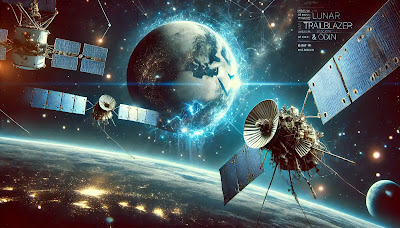
Lunar Trailblazer and Odin Spacecraft Face Technical Issues After IM-2 Launch

Introduction 

The Lunar Trailblazer and Odin spacecraft, both part of critical space exploration missions, have encountered unexpected technical issues following their launch aboard the IM-2 mission. These problems raise concerns about mission success, requiring rapid assessment and troubleshooting from mission control.

Key Points of the Issue

1. Overview of Lunar Trailblazer and Odin Spacecraft

  • Lunar Trailblazer: A NASA-funded spacecraft designed to map water on the Moon and analyze surface hydration, contributing to future lunar exploration and Artemis missions.
  • Odin Spacecraft: A research satellite focusing on atmospheric and space weather studies, critical for understanding the space environment.

2. Issues Arising Post-Launch

  • Reports indicate communication difficulties and power fluctuations on one or both spacecraft.
  • Instruments onboard may not be responding as expected, raising concerns about data transmission and operational status.

3. Possible Causes of the Malfunction

  • Launch-Induced Vibrations: Strong mechanical stress during launch may have damaged sensitive components.
  • Power System Anomalies: A failure in solar panels or onboard power management could lead to reduced functionality.
  • Software or Hardware Glitches: Unexpected software bugs or electronic malfunctions can prevent normal spacecraft operations.

4. Impact on Scientific Objectives

  • If unresolved, these problems could hinder lunar water mapping efforts by the Lunar Trailblazer.
  • The Odin spacecraft's atmospheric studies could be delayed or compromised.

5. Efforts to Resolve the Issues

  • Mission control teams are analyzing telemetry data to diagnose the problem.
  • Software updates and remote commands may be used to restore communication or reboot systems.
  • Engineers may adjust spacecraft operations to optimize power consumption and extend mission life.

6. Future Implications

  • Risk Mitigation for Future Missions: Lessons learned will improve spacecraft designs for resilience against similar failures.
  • Backup Strategies for Critical Missions: The importance of redundancy in power and communication systems is emphasized.

Conclusion

While the Lunar Trailblazer and Odin spacecraft face unexpected hurdles, swift action by mission teams could recover their operations. Their success remains vital for lunar exploration and atmospheric research, paving the way for more ambitious space missions.


Update on Technical Challenges Facing Lunar Trailblazer and Odin Spacecraft Post-IM-2 Launch

Following the recent IM-2 mission launch on February 26, 2025, both NASA's Lunar Trailblazer and AstroForge's Odin spacecraft have encountered technical difficulties that jeopardize their respective missions.

Lunar Trailblazer: Communication and Power Anomalies

  • Initial Contact and Subsequent Issues: Post-launch, mission operators at Caltech's IPAC established communication with Lunar Trailblazer at 5:13 p.m. PST. However, telemetry soon indicated intermittent power system issues, leading to a complete loss of contact by 4:30 a.m. PST on February 27.


  • Mission Objectives at Risk: Designed to map lunar water and analyze surface hydration, Lunar Trailblazer's mission is critical for future lunar exploration. The current technical challenges threaten the collection of valuable data intended to support NASA's Artemis program.

Odin Spacecraft: Communication Challenges

  • Post-Deployment Communication Loss: AstroForge's Odin spacecraft, launched to scout asteroid 2022 OB5 for potential mining operations, has experienced communication issues post-deployment. The mission team is actively working to reestablish contact to proceed with the asteroid flyby mission.

  • Implications for Space Resource Utilization: Odin's mission aims to pioneer commercial asteroid mining by identifying viable targets for resource extraction. The current communication problems pose significant challenges to these objectives.

Ongoing Efforts and Outlook

Both mission teams are diligently analyzing telemetry data and exploring corrective measures to resolve the technical issues. The outcomes of these efforts are crucial for advancing lunar science and commercial space resource utilization.


NASA Prepares Orion Spacecraft for Solar Array Installation

NASA Prepares Orion Spacecraft for Solar Array Installation

NASA is advancing preparations for the Orion spacecraft by initiating the installation of its four solar array wings, a critical step for the upcoming Artemis missions. These arrays are essential for providing the necessary power to support both crewed and uncrewed missions to the Moon and beyond.

Key Developments:

  1. Preparation for Solar Array Installation:

    • Technicians at NASA's Kennedy Space Center have relocated Orion from its assembly stand to facilitate the installation of the four solar array wings.

  2. Functionality of Solar Arrays:

    • Each of the four solar array panels is designed to generate approximately 11 kilowatts of power, collectively spanning about 63 feet. These arrays are integral components of Orion's European Service Module, which supplies power, propulsion, air, and water to the spacecraft.

  3. Protective Measures During Launch:

    • Following the installation of the solar arrays, technicians will attach three 14-foot-tall fairing panels to Orion's service module. These panels serve as protective shells, shielding the solar arrays from the heat, wind, and acoustics encountered during launch and ascent. Additionally, they help redistribute the load between Orion and the Space Launch System (SLS) rocket during liftoff.

  4. Collaborative Effort:

    • The installation process is a collaborative endeavor involving teams from NASA, Lockheed Martin, the European Space Agency (ESA), Airbus Defence, and Airbus Netherlands. Their collective expertise ensures the precise integration of the solar arrays with Orion's service module.

These advancements are pivotal as NASA progresses toward the Artemis missions, aiming to return humans to the Moon and explore deeper into space.


Redeeming India’s Nuclear Power Promise: A Clean Energy Imperative for 2047

Introduction: A Nuclear Vision for Viksit Bharat@2047 As India marches toward its ambitious goal of becoming a developed nation by 2047, en...