Showing posts with label SpaceTechnology. Show all posts

Quantum Satellite: The Future of Secure Communication
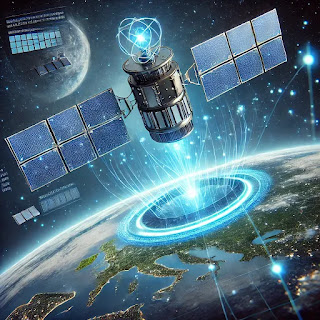
India is set to revolutionize secure communications by launching its first quantum satellite within the next 2-3 years. This ambitious initiative will place India at the forefront of quantum technology, enhancing cybersecurity, data protection, and encrypted communication. With advancements in Quantum Key Distribution (QKD) and the National Quantum Mission (NQM), India is making significant strides in next-generation secure networks.

In this article, we explore quantum satellites, how they work, their benefits, and their impact on global communication security.


What is a Quantum Satellite?

A quantum satellite is a next-generation communication satellite that leverages quantum physics principles to ensure unbreakable encryption and secure data transmission. Unlike conventional communication systems, quantum satellites use quantum mechanics-based encryption, making them immune to cyberattacks and eavesdropping.

How Does a Quantum Satellite Work?

  1. Quantum Key Distribution (QKD):

    • The satellite transmits encrypted quantum keys to ground stations.

    • These keys use quantum states of photons to encode data securely.

  2. Quantum Entanglement:

    • Entangled photons are transmitted from the satellite.

    • Any interference instantly changes the state of the entangled particles, alerting the sender.

  3. Tamper-Proof Communication:

    • If an eavesdropper tries to intercept the quantum keys, the quantum state collapses.

    • This makes it impossible to steal data without detection.

By integrating QKD and quantum entanglement, quantum satellites provide unprecedented security for global communications.


Quantum Key Distribution (QKD): The Core Technology

What is QKD?

Quantum Key Distribution (QKD) is a technology that allows two parties to securely exchange encryption keys using quantum particles like photons. It is the foundation of quantum-secure communication.

How Does QKD Work?

  • Photon Transmission: Secure quantum keys are sent using individual light particles (photons).

  • Quantum Entanglement: If a hacker attempts to intercept the key, the quantum state of photons changes immediately, rendering the data unreadable.

  • Key Validation: The system detects unauthorized access, ensuring secure key exchange.

Why is QKD Unbreakable?

  • Traditional encryption can be hacked by supercomputers.

  • QKD follows the laws of quantum mechanics, which prevent data interception without alerting the users.

  • Even future quantum computers will be unable to break QKD encryption.


National Quantum Mission (NQM): India’s Quantum Leap

What is the National Quantum Mission (NQM)?

The National Quantum Mission (NQM) is a flagship initiative by the Government of India, designed to boost research, innovation, and industrial applications in quantum technology.

Key Features of NQM:

  • Launched by PM-STIAC (Prime Minister’s Science, Technology & Innovation Advisory Council).

  • ₹6003.65 Crore budget allocated for 2023-2031.

  • Focuses on scientific research and industrial R&D.

  • Aims to develop a strong quantum ecosystem in India.

Four Thematic Hubs (T-Hubs) Under NQM:

  1. Quantum Computing: Development of advanced quantum processors, algorithms, and computing systems.

  2. Quantum Communication: Enhancing secure data transmission and cryptography.

  3. Quantum Sensing & Metrology: Creating high-precision sensors for defense, healthcare, and space applications.

  4. Quantum Materials & Devices: Developing quantum materials and semiconductors for next-gen technology.

NQM will position India as a global leader in quantum technology, ensuring strategic dominance in secure communications, computing, and sensing applications.


Benefits of Quantum Satellites

1. Unhackable Communication

  • Traditional encryption is vulnerable to hacking.

  • Quantum satellites provide tamper-proof, secure communication.

  • Military, government, and financial institutions will benefit from ultra-secure networks.

2. Advanced Cybersecurity

  • Cyber threats and espionage are increasing globally.

  • QKD-based satellites will protect sensitive data from cyberattacks.

  • Ensures secure financial transactions, defense communications, and diplomatic messages.

3. Next-Gen Space Technology

  • India will join global leaders like China and the USA in quantum satellite research.

  • Strengthens India’s role in space-based quantum communication.

4. Scientific and Industrial Innovation

  • Encourages collaboration between academia, startups, and industries.

  • Boosts R&D in quantum materials, sensors, and AI applications.

5. Secure Internet and Cloud Computing

  • Enables quantum-secure cloud storage and internet communication.

  • Protects user data from future cyber threats.


Challenges in Quantum Satellite Implementation

1. High Development Costs

  • Quantum technology requires expensive R&D.

  • Large investments are needed for infrastructure and skilled workforce.

2. Complex Engineering

  • Requires advanced satellites, precision instruments, and entangled photon generators.

  • The transmission of quantum signals over long distances is still a challenge.

3. Global Competition

  • China has already launched quantum satellites like Micius.

  • India must accelerate research and development to remain competitive.

4. Adoption by Industries and Government

  • Organizations must upgrade existing networks to integrate quantum-safe communication.

  • Training programs are needed for professionals in quantum technology.

Despite these challenges, India’s quantum satellite initiative marks a revolutionary step towards secure communication.


FAQs on Quantum Satellites

1. What makes quantum satellites secure?

Quantum satellites use Quantum Key Distribution (QKD), which ensures that any attempt to intercept data alters the quantum state of photons, making hacking impossible.

2. How will quantum satellites benefit India?

They will enhance national security, cybersecurity, secure government communications, and financial data protection.

3. Which countries have quantum satellites?

China launched the world’s first quantum satellite, Micius, in 2016. The USA and Europe are also investing in similar technologies.

4. What is quantum entanglement?

It is a phenomenon where two particles remain connected, so changing one particle instantly affects the other, regardless of distance. This principle is used in quantum communication.

5. When will India launch its first quantum satellite?

India plans to launch its first quantum satellite within 2-3 years, advancing secure communication and national security.


Conclusion: India’s Quantum Future

India’s planned quantum satellite launch will establish the nation as a global leader in secure communication. With the National Quantum Mission, India is paving the way for quantum computing, cybersecurity, and next-gen space technology.

As the world moves toward quantum-secure internet and global networks, India’s advancements in quantum satellites will redefine secure communication, digital privacy, and cyber defense.

The future of communication is quantum, and India is ready to lead the way!

ISRO Successfully Tests Semi-Cryogenic Engine for Future Heavy-Lift MissionsBVC

ISRO Successfully Tests Semi-Cryogenic Engine for Future Heavy-Lift MissionsBVC

The Indian Space Research Organisation (ISRO) has achieved another significant milestone in its pursuit of advanced space propulsion technology. On [date], ISRO successfully conducted a crucial test of its semi-cryogenic engine, a key component required for future heavy-lift space missions. This breakthrough is expected to enhance India's space capabilities, paving the way for ambitious interplanetary missions and high-payload satellite launches.

Image

What is a Semi-Cryogenic Engine?

A semi-cryogenic engine is a type of rocket propulsion system that uses a combination of liquid oxygen (LOX) as an oxidizer and kerosene-based fuel. Unlike fully cryogenic engines that use both LOX and liquid hydrogen (LH2), semi-cryogenic engines are more cost-effective and offer higher thrust, making them ideal for heavy-lift launch vehicles.

Key Advantages of Semi-Cryogenic Engines

  1. Higher Thrust: Provides greater lifting capacity for large payloads.
  2. Cost-Effective: Uses kerosene instead of expensive liquid hydrogen.
  3. Storage and Handling: Easier to manage compared to cryogenic propellants.
  4. Reusability Potential: Can be adapted for future reusable launch systems.

Details of the Recent Test

The semi-cryogenic engine test was conducted at ISRO's propulsion test facility in [location]. The engine, developed as part of the Semi-Cryogenic Propulsion System (SCPS) program, successfully fired for [duration] seconds, demonstrating its operational efficiency and performance parameters.

Objectives of the Test

  • Validate the engine’s fuel combustion efficiency.
  • Assess its thrust generation capabilities.
  • Ensure system reliability for long-duration operations.
  • Optimize engine cooling and fuel mixture ratio.

Importance of Semi-Cryogenic Technology in Future ISRO Missions

ISRO's semi-cryogenic engines are being developed for the upcoming Unified Launch Vehicle (ULV) program, which aims to replace existing launch vehicles like the PSLV and GSLV series. These advanced engines will significantly enhance India’s ability to conduct:

  • Heavy Satellite Launches: Deployment of large communication and defense satellites.
  • Manned Space Missions: Support for Gaganyaan and beyond.
  • Deep Space Exploration: Boosting missions to the Moon, Mars, and beyond.
  • Reusable Launch Vehicles: Future adaptation for cost-efficient, reusable rockets.

Global Comparison: How ISRO’s Semi-Cryogenic Engine Stacks Up

ISRO joins an elite group of space agencies working on semi-cryogenic technology, including NASA, Roscosmos, and SpaceX. Countries like the USA and Russia have long relied on semi-cryogenic propulsion for their heavy-lift rockets, such as:

  • Falcon 9 (SpaceX): Uses RP-1 (kerosene) and LOX.
  • Soyuz Rocket (Russia): Semi-cryogenic engines for reliable space travel.
  • Delta IV (USA): Employs similar propulsion technology.

ISRO’s semi-cryogenic engine is expected to rival these global counterparts, strengthening India’s independent space launch capabilities.

Future of India’s Space Exploration with Semi-Cryogenic Engines

The successful test of the semi-cryogenic engine marks a crucial step in ISRO’s roadmap for future missions. Here’s what’s next:

  • Integrated Stage Testing: ISRO will conduct full-stage trials to validate the engine within a complete launch vehicle configuration.
  • First Launch with ULV: The new engine is expected to power the next generation of launch vehicles by [expected timeline].
  • Human Spaceflight Integration: Potential use in future versions of Gaganyaan missions.
  • Commercial Launch Market: Strengthening ISRO’s role in global satellite launch .

Conclusion

ISRO’s successful semi-cryogenic engine test is a game-changer in India’s space program. With enhanced thrust, cost-efficiency, and global competitiveness, this propulsion system will revolutionize future space exploration and heavy-lift missions. As India continues to make strides in space technology, the world eagerly awaits the next breakthrough from ISRO.

Redeeming India’s Nuclear Power Promise: A Clean Energy Imperative for 2047

Introduction: A Nuclear Vision for Viksit Bharat@2047 As India marches toward its ambitious goal of becoming a developed nation by 2047, en...